

What Is Sedona Framework? Open Programming for Field Controllers
8/16/2026
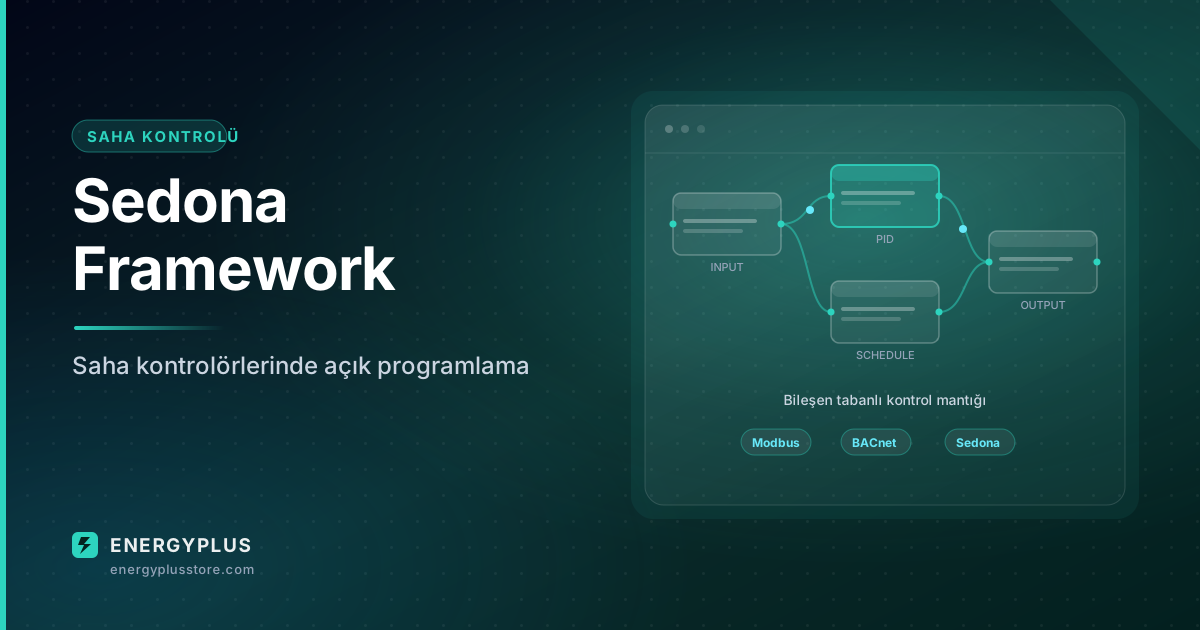
Sedona is an open-source control framework that runs on small field devices. Its component-based logic, its relationship with Niagara, and where it is used in practice.
Sedona Framework is an open-source control application framework designed to run on field controllers with limited memory. Developed by Tridium and released with open source code, it allows the same programming approach to be used across devices from different manufacturers.
The core idea: component-based programming
In Sedona an application is built by wiring together small function blocks called components. A temperature input, a PID block, a scheduler and an analogue output are placed as boxes and the links between them are drawn. Control logic is created visually, without writing text-based code.
This is a real advantage for the field technician: changing a setpoint or disabling a block during commissioning does not require recompiling and re-flashing code.
Sedona and Niagara — how they relate
The two are often confused. Put simply:
- Sedona — control logic running at field level, inside the controller. Small footprint, real-time, vendor-independent.
- Niagara — the supervisory and integration platform running at a higher level on a server or JACE. It unifies different protocols and provides graphics and reporting.
In a typical project the field controllers are programmed in Sedona, all of them connect to a Niagara station, and the building is operated through Niagara.
Why choose it?
- Vendor independence — the open framework avoids lock-in to a single brand.
- Low hardware cost — runs on modest processors and memory.
- Distributed intelligence — because the logic runs in the field, control continues even if the supervisory system goes offline. In HVAC applications this is a critical safeguard.
- Common protocol support — field integration via Modbus RTU/TCP and BACnet.
Where is it used in practice?
Air handling unit control, fan coil and VAV boxes, heat substations, lighting scenarios and energy monitoring are the most common applications. Especially in projects with many similar spaces, copying one prepared Sedona application to all devices shortens commissioning time considerably.
Points to watch
Sedona's strength comes from its simplicity; it is not suited to complex mathematics or heavy data processing. Because of the memory limit, the number of components must be watched as the application grows. Inter-device communication load is also directly tied to how the field network is designed.
At EnergyPlus we supply Sedona-based programmable controllers and programming tools. Browse our catalogue or get in touch for project support.