
Tridium Niagara Framework: Protocol-Independent Integration in Building Automation
8/16/2026
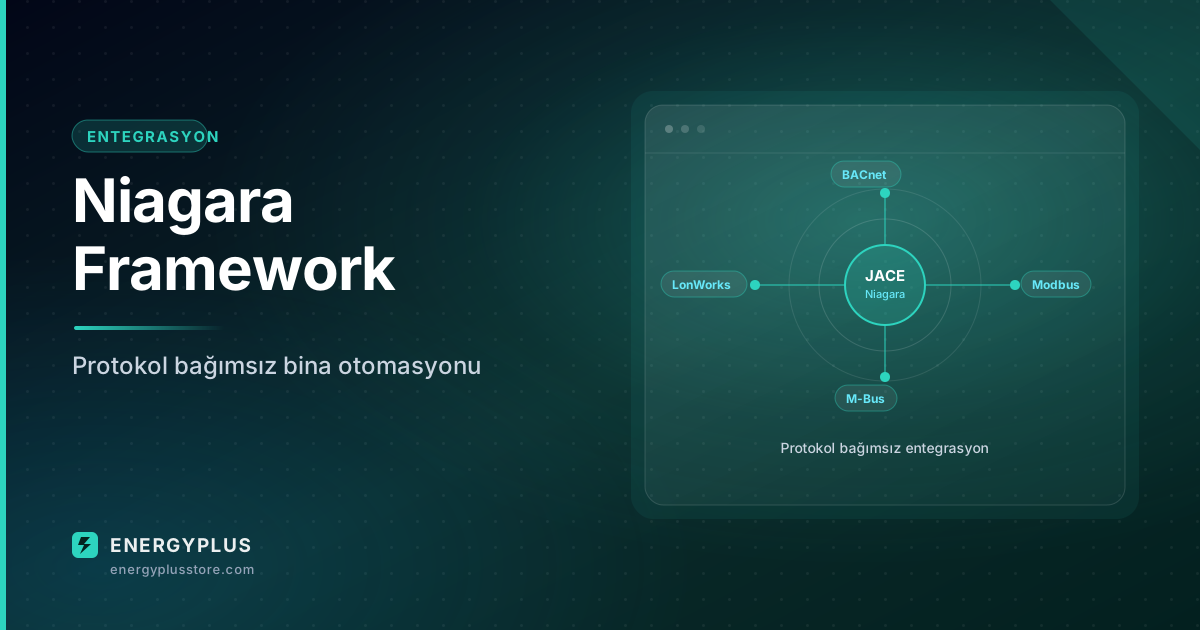
Niagara is an integration platform that brings devices of different brands and protocols under one roof. Its architecture, the JACE concept, and the benefits it brings to projects.
The oldest problem in building automation is integration: the air handling unit comes from one brand, the meters from another, and the fire and lighting systems speak entirely different protocols. Tridium Niagara Framework is a software platform developed to solve exactly this.
The core approach: everything is an "object"
Niagara converts every connected device and data point into a common object model, independent of its protocol. A temperature read over Modbus and a temperature read over BACnet are handled identically inside the platform. Graphics, alarm rules and reports are all built on this common model.
The practical consequence: when a device changes in the field, you do not have to rewrite the graphics and logic in the layer above.
What is a JACE?
A JACE (Java Application Control Engine) is the field supervisory hardware that Niagara runs on. It speaks to field controllers at protocol level, collects data, runs logic and scheduling on board, and forwards data to a supervisor or the cloud when needed. Even if the internet connection drops, control and trend logging on the JACE continue.
Supported protocols
- BACnet (IP and MS/TP) — the common language of building automation
- Modbus (RTU and TCP) — field devices, meters, drives
- LonWorks, M-Bus, OPC, SNMP and others, extensible by adding drivers
What does it bring to a project?
- A single interface — different systems are monitored and managed in one graphical environment.
- Central alarms and trends — fault tracking and energy analysis from one place.
- Scalability — the same architecture serves a single building or a multi-site campus.
- Longevity — field hardware can be renewed while the upper layer is preserved, extending the life of the investment.
Using it together with Sedona
The common and efficient architecture is this: field control runs distributed on Sedona-based controllers, while Niagara collects, supervises and reports on them. This delivers both supervisor-independent field safety and central management at the same time.
Points to watch
Niagara is a powerful platform, but its licensing depends on point count and drivers; this item should be budgeted from the outset. In addition, a poorly conceived point naming standard makes maintenance difficult as projects grow — a naming convention should be agreed on day one.
For Niagara integration and field controllers, get in touch.