

How to Size a Control Valve? (Calculator)
8/16/2026
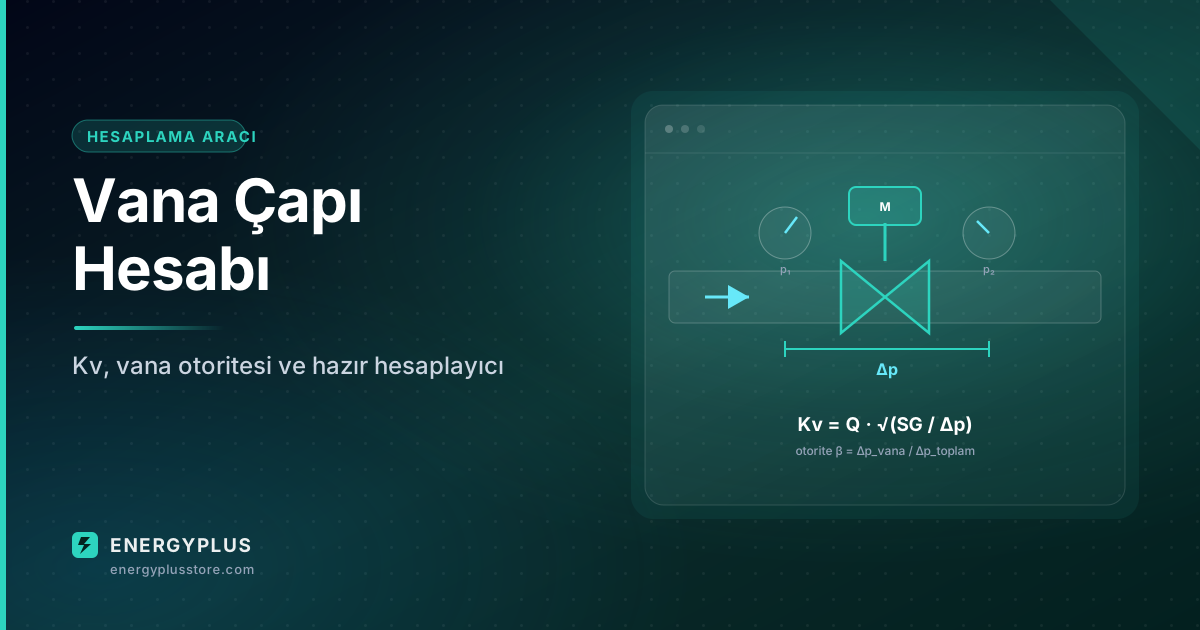
It is Kv, not diameter, that governs valve selection. Kv from thermal load, valve authority, and a ready calculator.
The most common mistake in control valve selection is fitting a valve equal to the pipe diameter. What governs is not the diameter but the Kv value.
What is Kv?
Kv is the water flow rate through the valve under a 1 bar differential pressure (m³/h). The required Kv is found as:
Kv = Q · √(SG / Δp)
If you start from a thermal load, the flow rate is calculated first: Q = 3600·P / (ρ·cp·ΔT). For water this reduces in practice to Q ≈ 0.86·P/ΔT.
Why is valve authority critical?
Authority is β = Δp_valve / (Δp_valve + Δp_circuit). Below 0.3 the valve characteristic distorts: most of the flow passes within the first 20% of travel and modulating control effectively becomes on/off. Temperature swings, and the pump and boiler run unnecessarily.
Why is an oversized valve a problem?
An oversized valve permanently operates at partial opening — the least linear region of the flow-versus-travel relationship. Seat wear and noise also increase.
Calculator
Control Valve Sizing
Kv value and suggested DN from thermal load or flow rate
Δp is the pressure drop across the valve when fully open. Kv is the water flow rate under 1 bar Δp (m³/h). SG is 1 for water and higher for glycol.
Circuit Δp = pressure loss of the circuit excluding the valve. Used for authority.
- Flow rate
- 4,3 m³/h
- Required Kv
- 7,85
- Cv
- 9,08
- Valve authority β
- 0,43
- Velocity
- 2,43 m/s
⚠ Important warnings
- This tool is for PRELIMINARY sizing only; it does not replace final valve selection.
- Cavitation, noise, choked flow (FL/xT), viscosity and valve characteristic (equal-percentage/linear) are not accounted for.
- Kvs values represent a typical catalogue series and vary by manufacturer. Verify the selection with the manufacturer software.
- Velocity is computed assuming the pipe inner diameter equals DN — the actual bore depends on wall thickness.
- Responsibility rests with the design engineer. EnergyPlus cannot be held liable for the results of this calculation.